Last Updated:

Medical records and deposition transcripts almost never tell the exact same story.
You’ll have a plaintiff swear under oath they’ve never had back issues, only for you to dig up an old urgent care note treating a lumbar strain.
But pinning down a usable contradiction between the two is maddening. When you spot a mismatch, you're immediately stuck trying to figure out what actually happened.
Did the deponent genuinely forget a random 15-minute clinic visit from three years ago? Did a rushed doctor just copy-paste an inaccurate chart note? Or is it simply a phrasing issue, where the witness testified about "lower back pain" but the triage nurse wrote down "sciatica"?
If you try to weaponize every little discrepancy, opposing counsel might explain them away and make you look desperate. This simple guide is meant to help you sift through the noise, map the testimony against the chart, and figure out if what you've found is an actual contradiction in a medical deposition (or not).
Let’s begin.
TL;DR
To spot and confirm contradictions between medical records and depositions:
Build a medical chronology: Compare testimony and medical records side by side across identical timeframes and issues.
Verify original sources: Double-check original records and transcripts directly to confirm the conflict isn't just an indexing or transcription error.
Account for qualifiers: Retain specific phrasing, timeline qualifiers, and hedge words used by the witness (e.g., "to the best of my knowledge").
Investigate explanations: Rule out reasonable explanations like distinct injuries, misremembered dates, or pre-existing condition flare-ups.
Document the gap: Formally log confirmed conflicts alongside exact transcript page-and-line citations and medical record page numbers.
What counts as a contradiction between medical records and deposition testimony?
A contradiction exists when deposition testimony and a medical record make statements about the same fact that cannot both be true.
Here is a simple case.
A witness testifies, "I never saw anyone for my knee before the fall." A clinic note dated one year before the fall records a visit for right knee pain and a cortisone injection. If the note belongs to the witness and describes the same knee, both statements cannot be accurate.
However, before you call any difference a contradiction, these things have to match:
The record belongs to the witness and not to someone with a similar name.
Both sources describe the same body part or the same condition.
The record falls inside the time frame the testimony covers.
The question the witness answered actually covers what the record shows.
So where should you look first?
What types of contradictions show up between medical records and depositions?
When the chart and the transcript split apart, it usually happens in a few predictable places. Here are the most common types of contradictions you'll run into, along with a quick way to check each.
Prior injuries and treatment
The witness denies or downplays a problem the records show existed before the incident.
Someone testifies their neck was fine, but a chiropractor treated that person for neck pain 18 months earlier.
A man says he never hurt his knee, but an urgent care note shows a sprain two years ago.
Check first: Reread the question. "Ever" and "in the year before the accident" cover very different periods.
Symptom onset
The witness's account of when a symptom began doesn't match the first time it appears in the chart.
Someone says her headaches started the day of the crash, but the first record of them is five weeks later.
Another person says his back pain began at work, but an earlier note records back pain after moving furniture.
Check first: A symptom can start long before a doctor writes it down. It only conflicts if a note from that period records "denies headache" or something similar.
How the injury happened
The witness describes the accident one way, and the intake or triage note describes it another way.
A person testifies she slipped on a wet floor, but the triage note says she "tripped over a box."
They say they were rear-ended at a stoplight, but the ER note says "patient hit a parked car."
Check first: Find out who gave the history. A paramedic or family member may have supplied it, and nurses often paraphrase.
Treatment and follow-through
The witness's description of their care doesn't match what the providers recorded.
A woman says she went to every therapy session, but the clinic logged five missed visits.
A man says he took his pain medication daily, but the pharmacy shows one refill in three months.
Check first: Make sure the file is complete. Request the full records and billing ledger before treating a gap as a conflict.
Physical limitations
The witness claims limits that other records don't support.
A woman can't lift a gallon of milk, but a therapy note says she lifted bags of mulch that weekend.
A man can't stand for an hour, but his time sheets show full eight-hour shifts that month.
Check first: Compare the same time period, and weigh one-time effort against repeated activity. Lifting something heavy once is different from doing it every day at work.
The same five types apply to medical experts. If an expert's causation opinion assumes the patient had no earlier neck complaints, pre-accident records showing neck pain undercut the facts behind it.
Now let's look at how to check each one without overstating what you find.
How do you compare medical records with deposition testimony?
How should you document contradictions in a comparison table?
How do you turn medical record contradictions into deposition follow-up questions?
Turn each verified finding into a focused question that clarifies one specific fact. Most follow-up questions aim to clarify the scope of an answer or identify who supplied a history. Others ask directly about an earlier treatment event.
For example:
“When you said you never received treatment, did you mean therapy or any neck treatment at all?”
“What care did you receive at the visit documented on this date?”
“Did you give this history to the clinician yourself?”
Keep each question tied to one factual point. That gives counsel a clean issue to work with.
Handling all of this by hand works for a small file. It gets much harder as the record grows.
How can AI software help compare medical records with depositions?
A single personal injury claim stacks up fast because there are a dozen medical providers, months of billing, and hundreds of pages of deposition testimony.
At that scale, manual review means checking each answer against a dozen open documents tabs on their screen, completely missing the line buried among hundreds of pages that contradicts it.
This is the kind of problem InFactIQ solves.
InFactIQ is an AI claims and litigation intelligence platform that reads the entire case file together and flags the points where testimony disagrees with the records and bills. Each finding links back to its source page, so your team can check the underlying record before deciding whether it is a genuine inconsistency.
For this type of review, InFactIQ can:
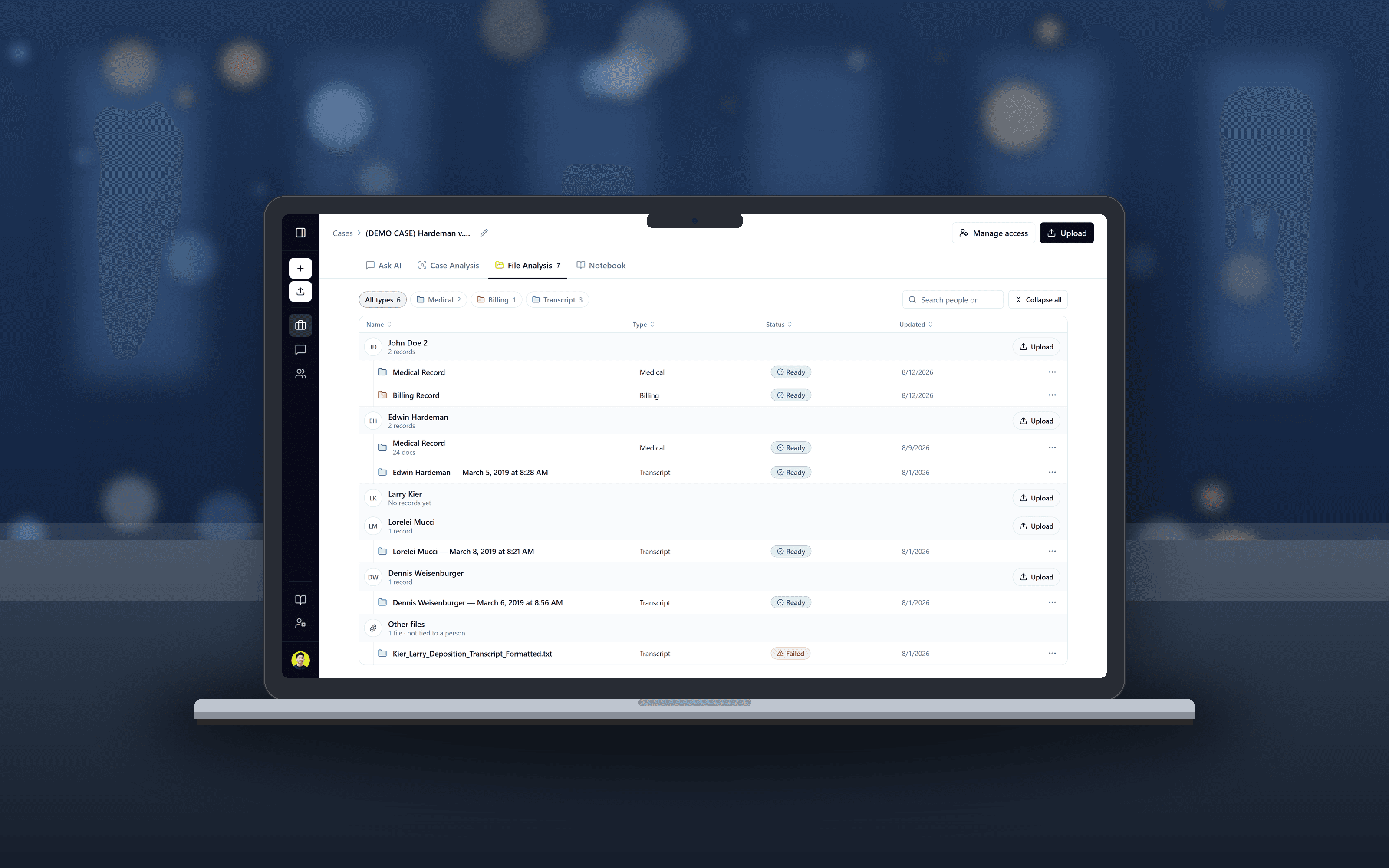
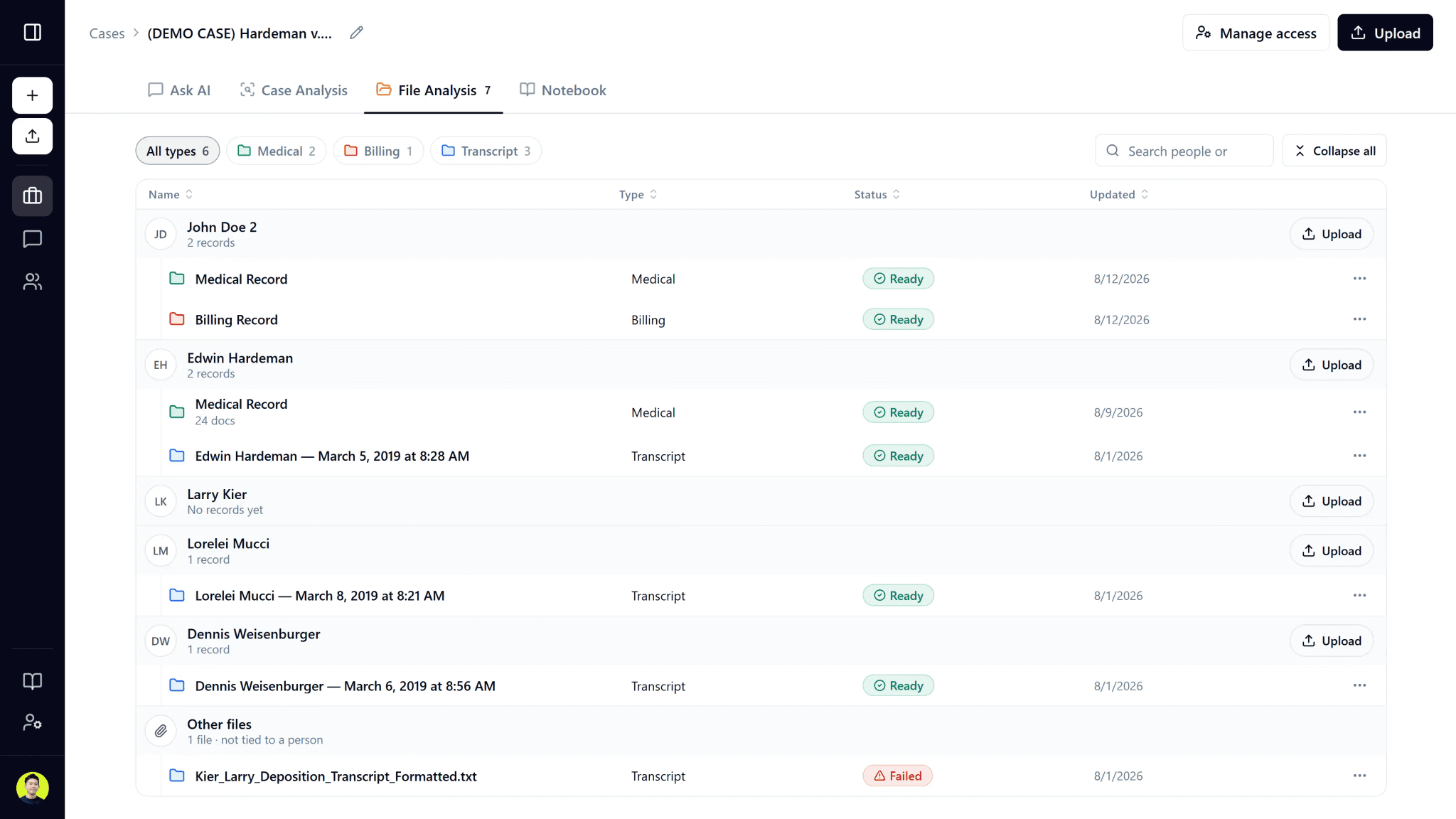
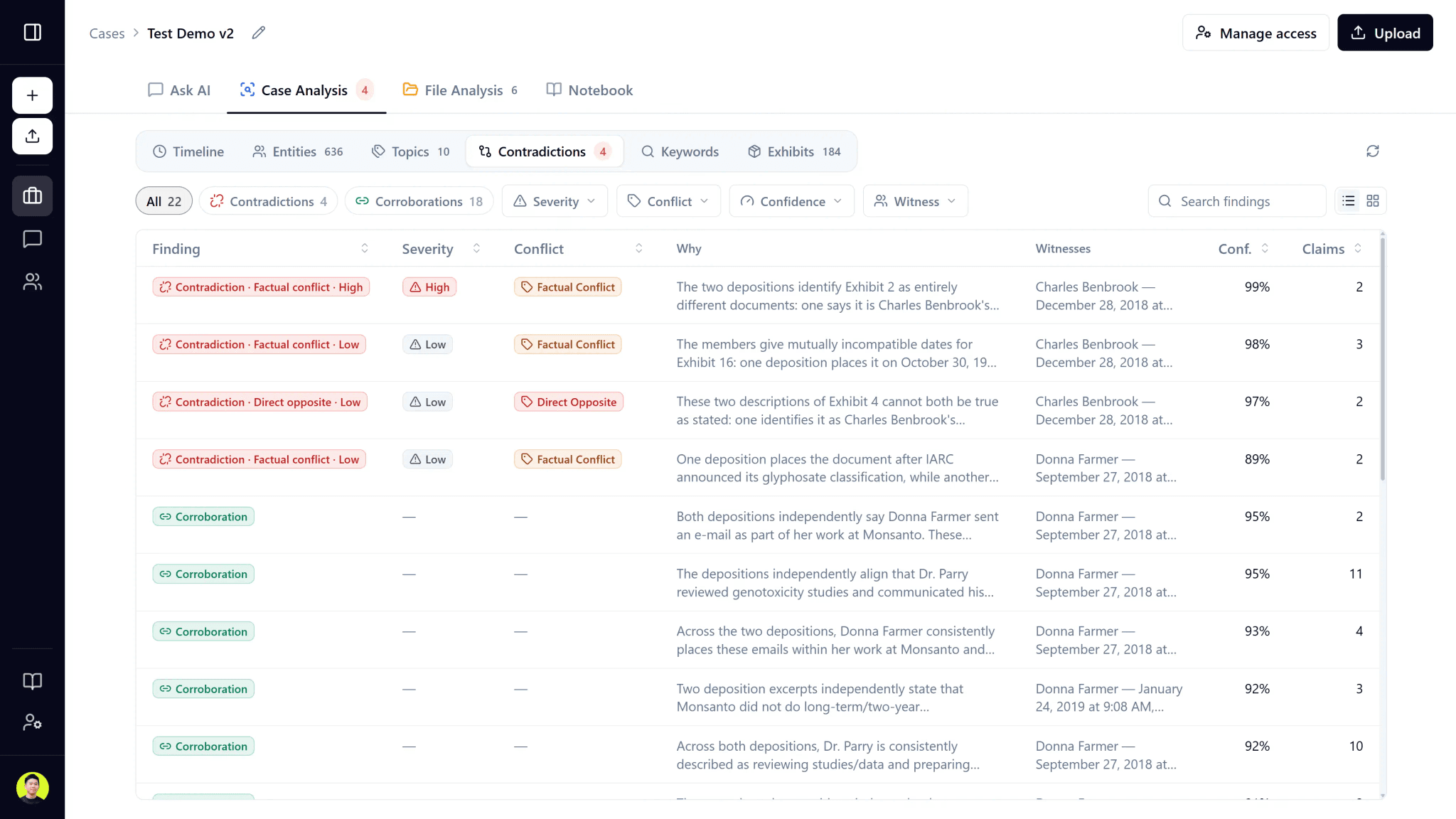
Compare testimony with medical records and bills: It flags conflicts across the file and can show deposition or Examination Under Oath (EUO) testimony alongside the medical record it conflicts with.
Keep the chronology connected: Its persistent timeline brings events from across the case into one view and can be filtered by date, record type, or billing incident.

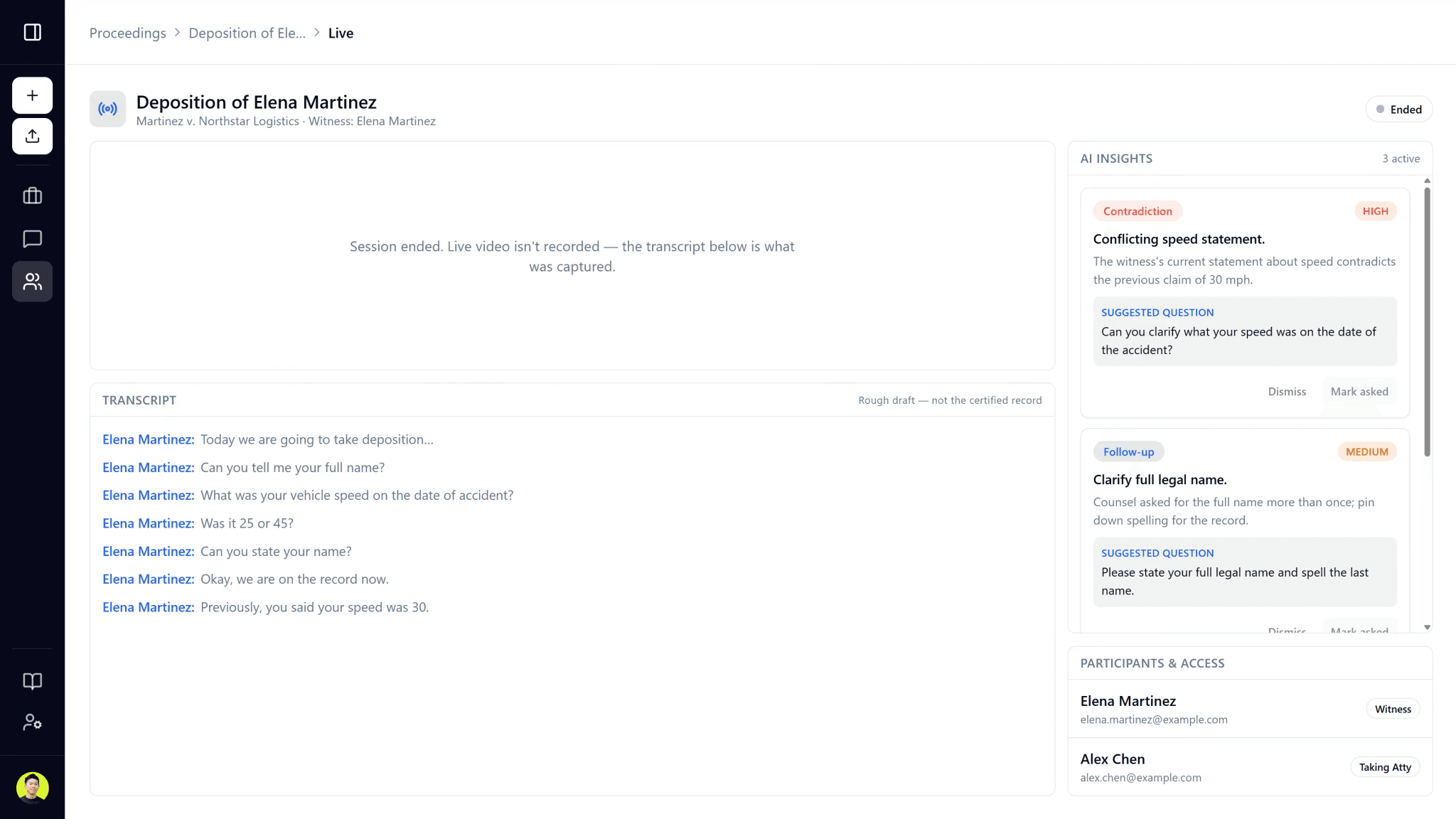
Carry those findings into the examination: Before a deposition or EUO, it can draft an outline from the case file and the team’s playbook. It also tracks contradictions, admissions, corroborations, and unanswered lines as testimony develops.
Recheck the testimony afterward: Once the examination ends, InFactIQ summarizes the testimony and compares it again with the claim file and demand package.
Apply your team’s existing review process: Playbooks can turn existing templates or standards into cited work products such as chronologies, issue charts, and deposition outlines.

The software does not decide whether a difference is meaningful. Your team still needs to check the source, consider the context, and decide whether the finding deserves follow-up. What AI changes is how much of the file you can cross-check before you get to that judgment.
Turn every contradiction into a question you can support
Think back to that old back-pain note from the beginning. By itself, it's just one line in a chart. It becomes valuable once you find the testimony it contradicts and verify the treatment it describes. From there, you account for the context and shape a question that both sources back up.
Before you carry a contradiction forward, make sure another reader can follow the evidence to the same point and clearly see what remains unresolved.
Book an InFactIQ demo to see how your team can review testimony and medical records together on your next case.
FAQs
Does a missing symptom in a medical record contradict later deposition testimony?
Not automatically. The note may be incomplete or focused on a different complaint, or it may come from a partial production. Compare explicit statements about symptoms and check the surrounding records.
Can AI find every contradiction between medical records and testimony?
No review process can promise that. Missing documents and poor scans can limit what any tool finds, and so can ambiguous wording or clinical context. Use AI to surface passages worth comparing, then verify the sources and judge what they mean.
Does an inconsistency prove that a witness is lying?
No. Memory lapses and simple misunderstandings can produce differences between testimony and records. Documentation errors and changes in a condition over time can do the same.