Best Medical Chronology Software for Defense Counsel and Claims Teams in 2026

Best Medical Chronology Software for Defense Counsel and Claims Teams in 2026

Last Updated:

What causes a medical case to slip away from you? 

Too often, it is one small detail buried in hundreds of pages. It could be a prior injury buried within hundreds of pages, or a treatment date that does not match the claimant’s story. 

Such tiny inconsistencies in the chronology can change the value of an entire claim.

The challenge for the defense is finding those inconsistencies before they get lost in the volume of records.

The stakes are also well known. EY estimates that indemnity leakage ranges from 7% to 14% of what carriers spend on litigated casualty claims, while defense and cost-containment costs the industry more than $23 billion a year. Catching a discrepancy early on protects that investment.

That is the job medical chronology software is supposed to do, but the platforms vary widely in how well they do it on a defense file. Some flag a missing record automatically while others leave that to you. 

This guide breaks down what defense counsel and claims teams should look for in medical chronology software and which platforms deserve a place on your shortlist.

What causes a medical case to slip away from you? 

Too often, it is one small detail buried in hundreds of pages. It could be a prior injury buried within hundreds of pages, or a treatment date that does not match the claimant’s story. 

Such tiny inconsistencies in the chronology can change the value of an entire claim.

The challenge for the defense is finding those inconsistencies before they get lost in the volume of records.

The stakes are also well known. EY estimates that indemnity leakage ranges from 7% to 14% of what carriers spend on litigated casualty claims, while defense and cost-containment costs the industry more than $23 billion a year. Catching a discrepancy early on protects that investment.

That is the job medical chronology software is supposed to do, but the platforms vary widely in how well they do it on a defense file. Some flag a missing record automatically while others leave that to you. 

This guide breaks down what defense counsel and claims teams should look for in medical chronology software and which platforms deserve a place on your shortlist.

Why Plaintiff-Focused Chronology Tools Fall Short for Defense Teams

Medical chronology software built for plaintiff firms can be useful, but it often approaches the record from the wrong direction for defense and claims teams.

A plaintiff chronology is meant to build a case. It pulls together the records that support causation and damages and turns them into a clear narrative.

A defense chronology has a different job. It needs to test that narrative. Instead of finding, “What in these records supports the claim?” it should help you ask, “What in these records does not support it?”

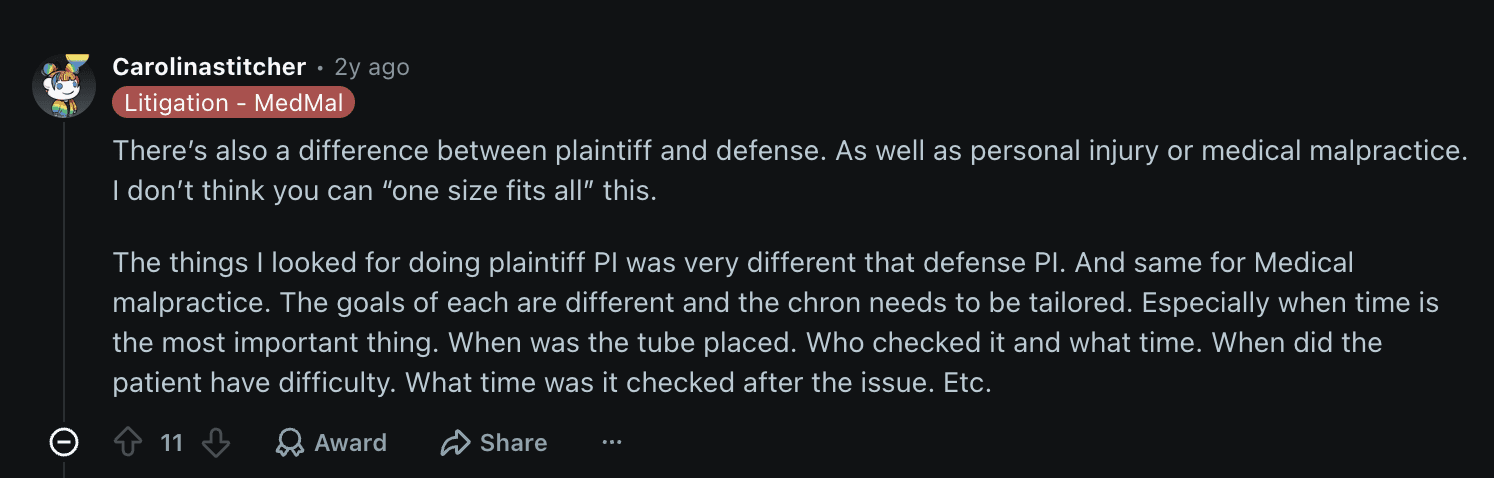
As this expert on Reddit clarifies, a “one-size-fits-all” doesn’t work for building proper chronologies:
Via Reddit

These are some reasons why plaintiff-based systems cannot help defense teams:

  • A plaintiff tool may highlight the note that says an injury was caused by the accident. For the defense, that statement is only one part of the picture. You also need to know whether the patient had the same complaint before the accident and whether the treatment history actually supports the level of damage being claimed.

  • The way records are handled can also be different. Defense teams often work from large production sets that include Bates numbers, duplicates, protective-order markings, and records from multiple sources. A chronology tool needs to preserve that context rather than treating the file as one clean set of medical records.

  • Continuity matters too. Claims can stay open for months or years while new records arrive in batches. Your chronology should update as the file grows instead of forcing the team to start over every time another production arrives.

Medical chronology software built for plaintiff firms can be useful, but it often approaches the record from the wrong direction for defense and claims teams.

A plaintiff chronology is meant to build a case. It pulls together the records that support causation and damages and turns them into a clear narrative.

A defense chronology has a different job. It needs to test that narrative. Instead of finding, “What in these records supports the claim?” it should help you ask, “What in these records does not support it?”

As this expert on Reddit clarifies, a “one-size-fits-all” doesn’t work for building proper chronologies:

Via Reddit

These are some reasons why plaintiff-based systems cannot help defense teams:

  • A plaintiff tool may highlight the note that says an injury was caused by the accident. For the defense, that statement is only one part of the picture. You also need to know whether the patient had the same complaint before the accident and whether the treatment history actually supports the level of damage being claimed.

  • The way records are handled can also be different. Defense teams often work from large production sets that include Bates numbers, duplicates, protective-order markings, and records from multiple sources. A chronology tool needs to preserve that context rather than treating the file as one clean set of medical records.

  • Continuity matters too. Claims can stay open for months or years while new records arrive in batches. Your chronology should update as the file grows instead of forcing the team to start over every time another production arrives.

What a Medical Defense Chronology Must Reveal

A medical defense chronology should do more than show what happened. It should identify the facts that could affect causation and the value of the claim. 

The most useful defense-first platforms find these five key categories from the medical record:

  1. Pre-incident baselines

What it is: Degenerative changes on old X-rays or MRIs or chronic pain complaints logged years before the accident are some common examples.

Why it matters: It separates the plaintiff’s underlying, age-related health issues from actual damages caused by the incident, hence directly challenging causation.

  1. Intervening events 

What it is: A second car accident, a slip-and-fall at home, a work injury, or a new sports injury occurring after the subject incident.

Why it matters: These events interrupt the chain of causation and prove that subsequent treatment or worsening symptoms may stem from an entirely unrelated event.

  1. Actionable treatment gaps 

What it is: Long delays between the injury and initial treatment, or unexplained multi-month breaks during active care.

Why it matters: Plaintiff tools flag gaps so attorneys can make excuses for them. Defense teams need these gaps framed as hard evidence that the injury was either minor, fully healed, or resolved.

  1. Questionable billing and referral networks

What it is: Treatments that far exceed standard clinical guidelines or suspicious attorney-referred treatment patterns.

Why it matters: It gives you the ammunition needed to challenge phantom damages and attack the medical bills under a reasonableness analysis.

5. Prior claims and lawsuit history

What it is: Records referencing past personal injury lawsuits or disability filings involving identical injuries

Why it matters: It establishes a pattern of prior injury and litigation and often exposes inconsistencies in what the plaintiff reported to treating physicians.

These categories, however, are not written in stone, and requirements vary from case to case. A medical malpractice case would need different details from a PI case. This Reddit comment makes the difference clearer:

Via Reddit

Regardless, these findings become necessary at different stages of the claim. Adjusters often need them early, before setting or revising reserves. Defense counsel may need the same evidence later to prepare for depositions, challenge causation, or give an expert a complete picture of the medical history.

The right chronology software should make those connections easier to see. It should not just tell you what happened. It should help you see what the record says about the claim.

A medical defense chronology should do more than show what happened. It should identify the facts that could affect causation and the value of the claim. 

The most useful defense-first platforms find these five key categories from the medical record:

  1. Pre-incident baselines

What it is: Degenerative changes on old X-rays or MRIs or chronic pain complaints logged years before the accident are some common examples.

Why it matters: It separates the plaintiff’s underlying, age-related health issues from actual damages caused by the incident, hence directly challenging causation.

  1. Intervening events 

What it is: A second car accident, a slip-and-fall at home, a work injury, or a new sports injury occurring after the subject incident.

Why it matters: These events interrupt the chain of causation and prove that subsequent treatment or worsening symptoms may stem from an entirely unrelated event.

  1. Actionable treatment gaps 

What it is: Long delays between the injury and initial treatment, or unexplained multi-month breaks during active care.

Why it matters: Plaintiff tools flag gaps so attorneys can make excuses for them. Defense teams need these gaps framed as hard evidence that the injury was either minor, fully healed, or resolved.

  1. Questionable billing and referral networks

What it is: Treatments that far exceed standard clinical guidelines or suspicious attorney-referred treatment patterns.

Why it matters: It gives you the ammunition needed to challenge phantom damages and attack the medical bills under a reasonableness analysis.

5. Prior claims and lawsuit history

What it is: Records referencing past personal injury lawsuits or disability filings involving identical injuries

Why it matters: It establishes a pattern of prior injury and litigation and often exposes inconsistencies in what the plaintiff reported to treating physicians.

These categories, however, are not written in stone, and requirements vary from case to case. A medical malpractice case would need different details from a PI case. This Reddit comment makes the difference clearer:

Via Reddit

Regardless, these findings become necessary at different stages of the claim. Adjusters often need them early, before setting or revising reserves. Defense counsel may need the same evidence later to prepare for depositions, challenge causation, or give an expert a complete picture of the medical history.

The right chronology software should make those connections easier to see. It should not just tell you what happened. It should help you see what the record says about the claim.

The Best Medical Chronology Software for Defense Counsel and Claims Teams


Built for

Reads testimony against the records

Clinical or expert review

Flags missing records or gaps

Works without switching your case system

InFactIQ

Carriers, TPAs, defense firms

Yes, core function

No, your team verifies

Yes, causation gaps

Yes, sits on Guidewire and Duck Creek

Wisedocs

Claims organizations

No

Yes, clinician in the loop

Yes

Yes

DigitalOwl

Insurers across multiple lines

No

No

Yes

Yes

Filevine MedChron

Firms already on Filevine

Sold as a separate product

No

Yes, bills against records

No, Filevine only

Casefleet

Litigation fact management

Only if you link facts by hand

No, you build it

No

No, Casefleet only

Supio

Plaintiff injury firms

No

Yes, verified by experts

Yes

Partial

EvenUp

Plaintiff injury firms

No

Add-on, not standard

Yes

Partial


Cross-evidence platforms

Almost all medical chronology tools focus on the medical record. Cross-evidence platforms go further by bringing deposition testimony and other sworn statements into the same analysis. That lets you compare what the claimant said with what the records actually show.


Top pick: InFactIQ

InFactIQ is an AI claims and litigation intelligence platform that reads the entire claim file, testimony included, and cites every finding to its source. 

It is best suited for carriers, SIU teams, TPAs, and insurance defense firms working files where testimony and medical evidence have to be reconciled.

Instead of analyzing medical records in isolation, InFactIQ connects testimony with medical records, bills and other claim documents, with each finding linked back to its source. Its workflow understands the file, reconciles conflicts and builds the position that survives.

Its core capabilities include:

  • Case Analysis: Combines depositions, medical records and bills into one body of evidence and shows the reasoning at both the case and document level.

  • Persistent timeline: Builds a chronological view of the facts and their significance, updating as new records arrive. You can filter it by record type, billing event or date.

  • Contradiction detection: Identifies conflicts across the file and links each finding to its source for use in depositions or claim evaluation.

  • Ask AI: Answers questions across thousands of pages while preserving the reasoning and sources behind each answer.

  • Entity and topic extraction: Connects people, organizations and issues across the file and links them to the relevant pages and lines.

InFactIQ also comes equipped with WitnessIQ, a system that runs the full life of a deposition or EUO and drafts the examination outline from the case record beforehand. It then re-tests the completed testimony against every page of the claim file and the demand package. 

For teams that need consistent review standards, Playbooks lets you upload your existing processes, including medical chronology standards, and apply them consistently across files with citations behind each finding.

For claims and SIU teams, the platform also flags anomaly clusters and causation gaps at intake, before reserves are set. It sits on top of your claims management system, pulling from Guidewire and Duck Creek or feeding them, so the analysis layer arrives without a migration. 

Note: InFactIQ does not retrieve records for you, does not sell a nurse review layer, and is not a case management system. If your bottleneck is getting records out of provider offices, solve that first. 

Almost all medical chronology tools focus on the medical record. Cross-evidence platforms go further by bringing deposition testimony and other sworn statements into the same analysis. That lets you compare what the claimant said with what the records actually show.


Top pick: InFactIQ

InFactIQ is an AI claims and litigation intelligence platform that reads the entire claim file, testimony included, and cites every finding to its source. 

It is best suited for carriers, SIU teams, TPAs, and insurance defense firms working files where testimony and medical evidence have to be reconciled.

Instead of analyzing medical records in isolation, InFactIQ connects testimony with medical records, bills and other claim documents, with each finding linked back to its source. Its workflow understands the file, reconciles conflicts and builds the position that survives.

Its core capabilities include:

  • Case Analysis: Combines depositions, medical records and bills into one body of evidence and shows the reasoning at both the case and document level.

  • Persistent timeline: Builds a chronological view of the facts and their significance, updating as new records arrive. You can filter it by record type, billing event or date.

  • Contradiction detection: Identifies conflicts across the file and links each finding to its source for use in depositions or claim evaluation.

  • Ask AI: Answers questions across thousands of pages while preserving the reasoning and sources behind each answer.

  • Entity and topic extraction: Connects people, organizations and issues across the file and links them to the relevant pages and lines.

InFactIQ also comes equipped with WitnessIQ, a system that runs the full life of a deposition or EUO and drafts the examination outline from the case record beforehand. It then re-tests the completed testimony against every page of the claim file and the demand package. 

For teams that need consistent review standards, Playbooks lets you upload your existing processes, including medical chronology standards, and apply them consistently across files with citations behind each finding.

For claims and SIU teams, the platform also flags anomaly clusters and causation gaps at intake, before reserves are set. It sits on top of your claims management system, pulling from Guidewire and Duck Creek or feeding them, so the analysis layer arrives without a migration. 

Note: InFactIQ does not retrieve records for you, does not sell a nurse review layer, and is not a case management system. If your bottleneck is getting records out of provider offices, solve that first. 

Claims-native record review

Wisedocs and DigitalOwl are built primarily for insurers rather than law firms. Their workflows are designed around claims teams, so the output emphasizes the findings adjusters and medical reviewers need to assess a claim and make decisions.


Top pick: Wisedocs

Wisedocs is an AI medical record review platform built for insurance claims rather than law firms. It takes unstructured claim records and returns indexed chronologies and summaries, with clinician review on every output. The company says its models are trained on more than 100 million documents.

It is also the most deliberate competitor here about courting defense work, with a dedicated page for defense lawyers and separate use cases for claims litigation and medical malpractice.

Its key strengths are:

  • Co-mingled record detection: Finds and separates another claimant's documents from your file.

  • Deduplication: Strips redundant pages automatically, so the same visit notes arriving across two productions do not get chronologized twice.

  • Handwritten detection: Extracts structured data from handwritten notes and scanned pages that defeat general-purpose OCR.

  • Timeline view: Organizes the claim history, highlights treatment gaps and lets users query the records through WiseChat.

The limitation is that Wisedocs remains a records platform. Compared with InFactIQ, it goes deeper on clinical review and record hygiene, while InFactIQ covers evidence Wisedocs does not, including deposition and EUO testimony.

For high-volume carriers, the two could work well together: Wisedocs for processing and reviewing medical records, and InFactIQ for reconciling those records with testimony.


Honorable mention: DigitalOwl

DigitalOwl is an AI platform built for insurance and legal professionals to read, organize, and summarize complex medical records. It uses natural language processing to turn thousands of pages of medical documents into source-cited, structured summaries.

DigitalOwl is now rebranding as ChartSwap Insights to combine its analysis engine with ChartSwap's nationwide retrieval network.

Some of the key features:

  • Click-to-evidence verification: Links every condition and date back to its page in the source record.

  • Case Notes: Uses AI agents to assemble a narrative covering condition progression, treatment non-compliance, and gaps in the record.

  • Demand package analysis: Compares the demand against medical and billing records to identify inconsistencies.

  • In-Depth Analysis Chat: Takes reasoning-based questions across a record set and returns answers in text and tables.

That demand package feature deserves attention from defense readers, since testing the other side's demand against the underlying records is central to this work.

DigitalOwl covers a broader range of insurance use cases, including life, disability, long-term care and P&C, so it is generally better suited to insurance reviewers than trial teams. Its retrieval capabilities are also still expanding. Once retrieval and analysis are fully integrated, it could offer something InFactIQ does not: helping obtain the records as well as analyze them.

Wisedocs and DigitalOwl are built primarily for insurers rather than law firms. Their workflows are designed around claims teams, so the output emphasizes the findings adjusters and medical reviewers need to assess a claim and make decisions.


Top pick: Wisedocs

Wisedocs is an AI medical record review platform built for insurance claims rather than law firms. It takes unstructured claim records and returns indexed chronologies and summaries, with clinician review on every output. The company says its models are trained on more than 100 million documents.

It is also the most deliberate competitor here about courting defense work, with a dedicated page for defense lawyers and separate use cases for claims litigation and medical malpractice.

Its key strengths are:

  • Co-mingled record detection: Finds and separates another claimant's documents from your file.

  • Deduplication: Strips redundant pages automatically, so the same visit notes arriving across two productions do not get chronologized twice.

  • Handwritten detection: Extracts structured data from handwritten notes and scanned pages that defeat general-purpose OCR.

  • Timeline view: Organizes the claim history, highlights treatment gaps and lets users query the records through WiseChat.

The limitation is that Wisedocs remains a records platform. Compared with InFactIQ, it goes deeper on clinical review and record hygiene, while InFactIQ covers evidence Wisedocs does not, including deposition and EUO testimony.

For high-volume carriers, the two could work well together: Wisedocs for processing and reviewing medical records, and InFactIQ for reconciling those records with testimony.


Honorable mention: DigitalOwl

DigitalOwl is an AI platform built for insurance and legal professionals to read, organize, and summarize complex medical records. It uses natural language processing to turn thousands of pages of medical documents into source-cited, structured summaries.

DigitalOwl is now rebranding as ChartSwap Insights to combine its analysis engine with ChartSwap's nationwide retrieval network.

Some of the key features:

  • Click-to-evidence verification: Links every condition and date back to its page in the source record.

  • Case Notes: Uses AI agents to assemble a narrative covering condition progression, treatment non-compliance, and gaps in the record.

  • Demand package analysis: Compares the demand against medical and billing records to identify inconsistencies.

  • In-Depth Analysis Chat: Takes reasoning-based questions across a record set and returns answers in text and tables.

That demand package feature deserves attention from defense readers, since testing the other side's demand against the underlying records is central to this work.

DigitalOwl covers a broader range of insurance use cases, including life, disability, long-term care and P&C, so it is generally better suited to insurance reviewers than trial teams. Its retrieval capabilities are also still expanding. Once retrieval and analysis are fully integrated, it could offer something InFactIQ does not: helping obtain the records as well as analyze them.

Case management platforms

These platforms put medical chronology directly inside the case management system your team already uses. That can save time and reduce duplicate work, but it also means the chronology is tied to that platform


Top pick: Filevine MedChron

MedChron is the chronology engine built into Filevine, the case management platform. Records classify themselves on upload, and the chronology updates automatically as new documents land in the matter.

Key features:

  • Automatic record classification: Sorts incoming records the moment they are uploaded, emailed, or faxed into Filevine.

  • Missing Records Check: Compares extracted medical bills against the chronology and flags dates of service where a bill exists but the treatment record does not.

  • Hyperlinked timeline entries: Connect every extracted date and provider back to the source document.

  • Automatic Bates numbering: Useful when the chronology has to line up with a production set.

The Missing Records Check is particularly useful for defense teams because it can surface billing and treatment discrepancies early.

The main limitation is platform dependency: you need to be a Filevine firm to use MedChron, so it is not an option for carriers, TPAs or firms using another case management system. Filevine also estimates that complex chronologies can take 15 to 20 hours to produce manually, but it does not disclose the methodology behind that figure.

MedChron and InFactIQ solve different problems. MedChron’s advantage is keeping the chronology inside Filevine, while InFactIQ can analyze the full claim file without requiring a case management change. That makes InFactIQ more flexible for carriers, TPAs and firms that are not on Filevine.


Honorable mention: Casefleet

Casefleet is a litigation fact-management platform where your team builds the chronology from individual facts linked to their sources. Its AI can propose facts from uploaded documents, but a human must review and approve each one before it enters the chronology.

Key features:

  • Fact-to-evidence linking: Connects each fact to supporting text in the source document.

  • AI-proposed facts: Extracts potential chronology entries and identifies people, organizations and other entities.

  • Chronology and issue management: Lets you organize facts, entities, issues and evidence in one case workspace.

  • Casey: Answers questions about the case with clickable citations to the underlying documents.

Casefleet also publishes its pricing. The current plans are $30 per user per month for Starter and $75 for Advanced AI, with 10,000 AI credits included per Advanced AI user each month.

The tradeoff with Casefleet is control. Casefleet is designed around attorney-directed fact management. The AI proposes facts, but your team decides what belongs in the chronology. That makes it attractive to teams that want to review and curate every finding, but less suited to teams looking for a highly automated medical-record processing workflow.

Casefleet gives attorneys more direct control over what enters the chronology and makes its pricing public. On the other hand, InFactIQ is more focused on automated analysis across the full claim file, including contradiction detection. Casefleet fits teams that want to drive the analysis themselves; InFactIQ fits teams that want more of that work automated.

These platforms put medical chronology directly inside the case management system your team already uses. That can save time and reduce duplicate work, but it also means the chronology is tied to that platform


Top pick: Filevine MedChron

MedChron is the chronology engine built into Filevine, the case management platform. Records classify themselves on upload, and the chronology updates automatically as new documents land in the matter.

Key features:

  • Automatic record classification: Sorts incoming records the moment they are uploaded, emailed, or faxed into Filevine.

  • Missing Records Check: Compares extracted medical bills against the chronology and flags dates of service where a bill exists but the treatment record does not.

  • Hyperlinked timeline entries: Connect every extracted date and provider back to the source document.

  • Automatic Bates numbering: Useful when the chronology has to line up with a production set.

The Missing Records Check is particularly useful for defense teams because it can surface billing and treatment discrepancies early.

The main limitation is platform dependency: you need to be a Filevine firm to use MedChron, so it is not an option for carriers, TPAs or firms using another case management system. Filevine also estimates that complex chronologies can take 15 to 20 hours to produce manually, but it does not disclose the methodology behind that figure.

MedChron and InFactIQ solve different problems. MedChron’s advantage is keeping the chronology inside Filevine, while InFactIQ can analyze the full claim file without requiring a case management change. That makes InFactIQ more flexible for carriers, TPAs and firms that are not on Filevine.


Honorable mention: Casefleet

Casefleet is a litigation fact-management platform where your team builds the chronology from individual facts linked to their sources. Its AI can propose facts from uploaded documents, but a human must review and approve each one before it enters the chronology.

Key features:

  • Fact-to-evidence linking: Connects each fact to supporting text in the source document.

  • AI-proposed facts: Extracts potential chronology entries and identifies people, organizations and other entities.

  • Chronology and issue management: Lets you organize facts, entities, issues and evidence in one case workspace.

  • Casey: Answers questions about the case with clickable citations to the underlying documents.

Casefleet also publishes its pricing. The current plans are $30 per user per month for Starter and $75 for Advanced AI, with 10,000 AI credits included per Advanced AI user each month.

The tradeoff with Casefleet is control. Casefleet is designed around attorney-directed fact management. The AI proposes facts, but your team decides what belongs in the chronology. That makes it attractive to teams that want to review and curate every finding, but less suited to teams looking for a highly automated medical-record processing workflow.

Casefleet gives attorneys more direct control over what enters the chronology and makes its pricing public. On the other hand, InFactIQ is more focused on automated analysis across the full claim file, including contradiction detection. Casefleet fits teams that want to drive the analysis themselves; InFactIQ fits teams that want more of that work automated.

Plaintiff-native platforms

These platforms were built to help plaintiff firms develop and value injury claims. That makes them useful to defense teams in two ways: as potential tools for understanding the medical record and as a way to understand how a plaintiff-side team may have built the demand sitting across the table.


Top pick: Supio
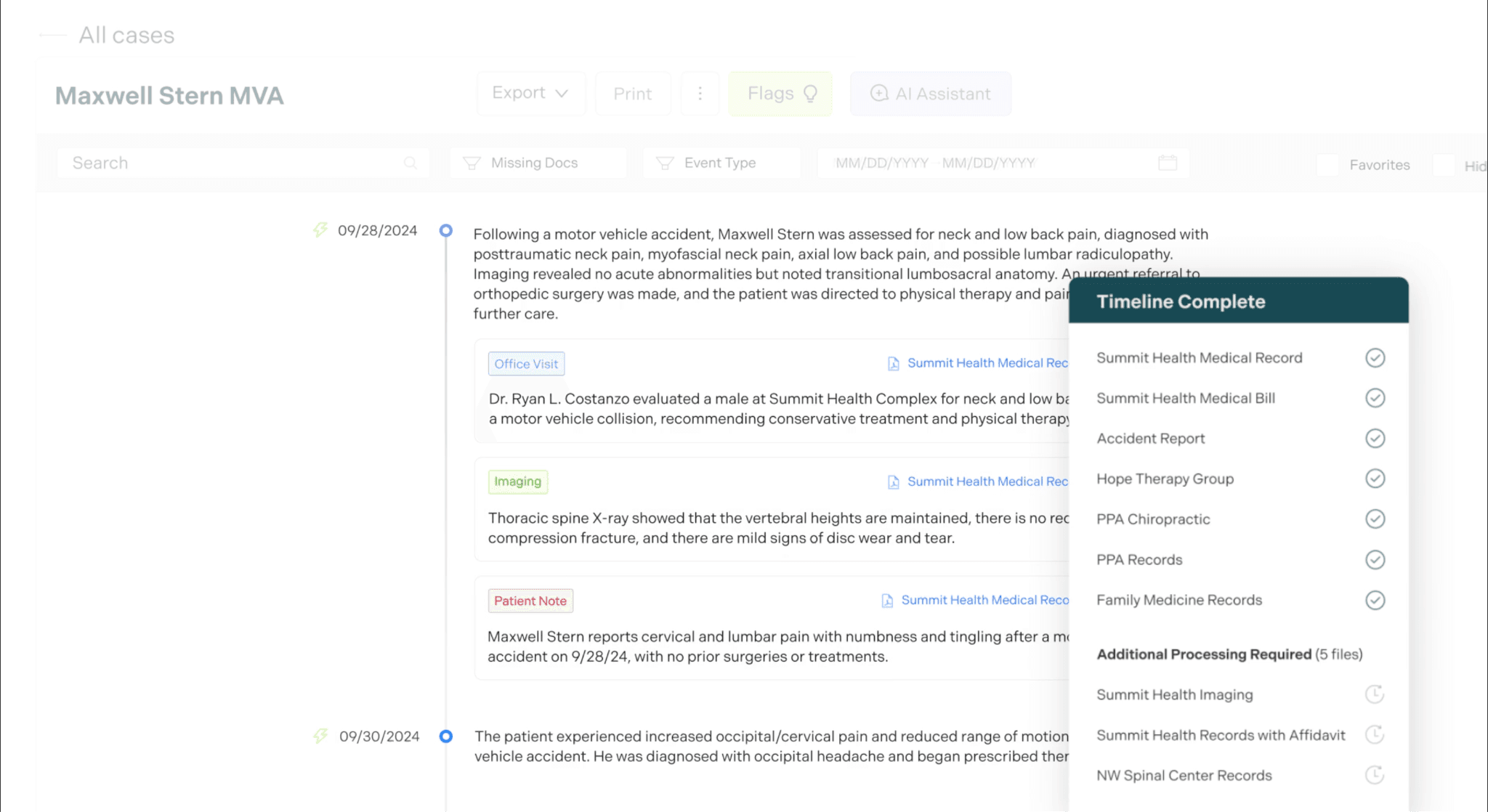
Supio is an AI platform built specifically for personal injury and mass tort firms. It combines medical-record analysis with case management, demand preparation and litigation support. Supio has raised $91 million and now integrates with Thomson Reuters Westlaw Advantage.

For chronology work, its key capabilities include:

  • Instant timelines: Starts building a chronology as documents arrive, with more complex items routed for human verification. A completed human-verified timeline follows within several business days.

  • Source-linked findings: Lets users trace facts back to the underlying records.

  • Case Signals: Flags treatment gaps, missing records, prior conditions and other issues that can affect case value or causation.

  • Supio Agent: Acts as an AI legal work assistant across the case and helps attorneys research the file, analyze evidence and complete case-specific tasks using the underlying matter data.

For a defense team, the bigger limitation is positioning. Supio is explicitly built for plaintiff law and is designed to help firms build cases, increase settlements and manage matters from intake through resolution. It can identify contradictions and gaps, but its workflow is designed to strengthen the plaintiff’s case rather than systematically test that case against opposing testimony.


Honorable mention: EvenUp
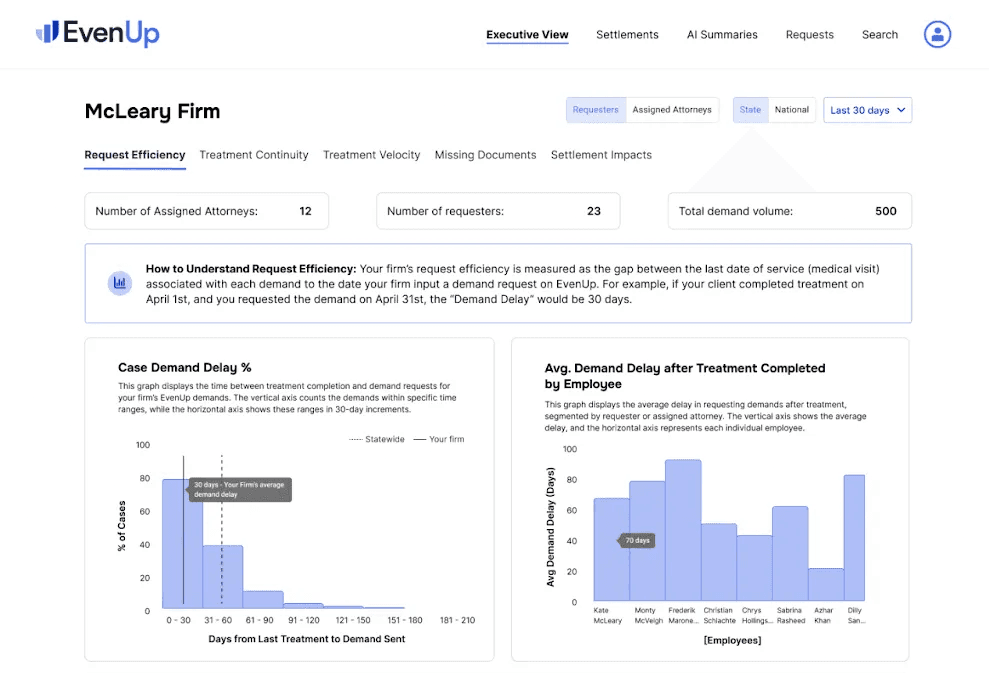
EvenUp is another major AI platform for personal injury firms. Its MedChrons product feeds into a broader platform that handles medical management, demands, negotiation and case preparation.

For medical chronology, the important features are:

  • Interactive timelines: Organize treatment into a searchable chronological view with links back to the underlying records.

  • Diagnostic and ICD code surfacing: Highlights diagnoses, high-impact diagnostics and important treatment milestones.

  • Prior-history analysis: Finds earlier treatment and conditions that may affect causation and defense strategy.

  • Case-management integrations include Litify, SmartAdvocate and CASEpeer.

For defense teams, EvenUp is arguably more useful as intelligence than as a buying choice. Its chronology is designed to help plaintiff firms understand the medical story, identify factors affecting case value and prepare stronger demands.

A treatment gap that EvenUp helps a plaintiff understand can become a line of questioning for the defense when the same evidence is analyzed in a defense-oriented workflow.

These platforms were built to help plaintiff firms develop and value injury claims. That makes them useful to defense teams in two ways: as potential tools for understanding the medical record and as a way to understand how a plaintiff-side team may have built the demand sitting across the table.


Top pick: Supio

Supio is an AI platform built specifically for personal injury and mass tort firms. It combines medical-record analysis with case management, demand preparation and litigation support. Supio has raised $91 million and now integrates with Thomson Reuters Westlaw Advantage.

For chronology work, its key capabilities include:

  • Instant timelines: Starts building a chronology as documents arrive, with more complex items routed for human verification. A completed human-verified timeline follows within several business days.

  • Source-linked findings: Lets users trace facts back to the underlying records.

  • Case Signals: Flags treatment gaps, missing records, prior conditions and other issues that can affect case value or causation.

  • Supio Agent: Acts as an AI legal work assistant across the case and helps attorneys research the file, analyze evidence and complete case-specific tasks using the underlying matter data.

For a defense team, the bigger limitation is positioning. Supio is explicitly built for plaintiff law and is designed to help firms build cases, increase settlements and manage matters from intake through resolution. It can identify contradictions and gaps, but its workflow is designed to strengthen the plaintiff’s case rather than systematically test that case against opposing testimony.


Honorable mention: EvenUp

EvenUp is another major AI platform for personal injury firms. Its MedChrons product feeds into a broader platform that handles medical management, demands, negotiation and case preparation.

For medical chronology, the important features are:

  • Interactive timelines: Organize treatment into a searchable chronological view with links back to the underlying records.

  • Diagnostic and ICD code surfacing: Highlights diagnoses, high-impact diagnostics and important treatment milestones.

  • Prior-history analysis: Finds earlier treatment and conditions that may affect causation and defense strategy.

  • Case-management integrations include Litify, SmartAdvocate and CASEpeer.

For defense teams, EvenUp is arguably more useful as intelligence than as a buying choice. Its chronology is designed to help plaintiff firms understand the medical story, identify factors affecting case value and prepare stronger demands.

A treatment gap that EvenUp helps a plaintiff understand can become a line of questioning for the defense when the same evidence is analyzed in a defense-oriented workflow.

Why Standard Metrics are Not Enough for Defense Teams

It's clear that defense chronology must find the needle in the haystack, i.e., the pre-existing conditions, treatment gaps, or billing errors that test a plaintiff's narrative.

However, if your software misses those critical defense findings, the entire strategy fails. To protect your claims, you need to look past software vendor claims and evaluate accuracy where it actually counts.


Vendors claim high accuracy, but show no proof

Software vendors have a habit of claiming high accuracy percentages. However, there is no industry standard or third-party testing for medical AI.

Every percentage in a sales pitch comes from the vendor's own internal testing, without public methodology or independent validation. You cannot meaningfully compare one vendor's claims to another's.

In a survey of over 200 personal injury attorneys, 99% stated they will not use AI output they cannot verify. For defense teams, every line in a chronology must hyperlink directly to the original source page in the medical file.

No independent benchmark exists for medical chronology accuracy. Every percentage in a vendor deck comes from the vendor’s own testing, usually without published methodology or third-party validation, so the numbers cannot be meaningfully compared.


General accuracy is a misleading metric

Vendors usually talk about overall "extraction accuracy," but general accuracy is not the best metric for defense teams.

A misspelled doctor’s name or a slightly mistyped appointment date is frustrating, but easy for your team to catch and fix.

However, missing a single pre-incident shoulder surgery from six years ago completely alters your exposure and reserve calculations. Because you cannot look for evidence the software missed entirely, these false negatives are almost impossible to catch during a routine review.

That is why you shouldn’t rely on demo files. Take a closed file where you already know every pre-existing condition and intervening event. Run it through the platform and measure how many critical defense facts it fails to find.


The human review model directly impacts accuracy

Behind every platform's marketing, there is a vastly different mix of AI and human verification. Your workflow needs to determine which trade-off makes sense:

Fully automated: Fastest and cheapest, but all quality assurance falls to your team.

Vendor legal review: A non-clinical reviewer checks the output before delivery.

Mandatory expert verification: More thorough, but slower and more likely to stretch turnaround into days.

Clinician in the loop: A nurse or physician reviewer applies clinical judgment, which matters most when the chronology involves apportionment or causation.

Compliance Requirements for Medical Chronology Software in 2026

Finding critical medical facts is useless if your tool breaches privacy laws or fails court scrutiny. Just as defense teams need specific accuracy models, they also face compliance and regulatory standards that plaintiff tools completely ignore.


HIPAA does not work the way most people expect

A BAA is not automatically required for every medical chronology vendor. It depends on whether HIPAA applies to the matter.

HIPAA covers healthcare providers, health plans, and clearinghouses. P&C insurers generally are not health plans, so HIPAA does not automatically extend to their vendors. 

The key question is who your client is:

  • Provider or hospital defense: The client is a HIPAA-covered entity, so a chronology vendor acting on its behalf will generally need a BAA.

  • Auto, liability or workers’ comp defense: HIPAA may not apply directly. Privacy obligations may instead come from authorizations, subpoenas, protective orders, state laws and laws such as Gramm-Leach-Bliley.

Before choosing a vendor, ask which privacy and compliance rules apply to your specific matter and how the vendor meets them.


AI Vendor oversight requirements for Insurers in 2026

The NAIC’s Model Bulletin on the Use of Artificial Intelligence Systems by Insurers calls for oversight, testing, controls for third-party AI and ongoing accountability, including for claims operations.

That means a chronology vendor may need to provide documentation such as model testing and validation, information about third-party AI models, security and privacy controls and an audit trail of how findings were produced.

Defense counsel has similar obligations. ABA Formal Opinion 512 says lawyers using AI must understand its capabilities and risks while protecting client information and properly supervising its use.

Before choosing a vendor, ask how your data is handled and what records you can retain to document that oversight.


See What InFactIQ Finds in Your Own Claim File

The right medical chronology software depends on where your team is losing time. 

To recap, Wisedocs makes sense for high-volume claims review. Filevine MedChron is a natural fit for firms already working in Filevine and Casefleet, and suits teams that want tighter control over what enters the chronology. Supio and EvenUp are worth considering when you are reviewing a demand built on plaintiff-side analysis.

But the biggest question mark is whether your software can analyze the full body of evidence. A claimant’s testimony may tell one story while the medical records tell another. If your chronology only reads the records, you may never see that conflict.

That is where InFactIQ is different. It brings transcripts, medical records and bills into one case analysis and identifies contradictions while linking each finding to its source. The chronology becomes more than a record of treatment. It becomes a way to test the claim.

Book a demo and let InFactIQ run one of your claims end to end.


Finding critical medical facts is useless if your tool breaches privacy laws or fails court scrutiny. Just as defense teams need specific accuracy models, they also face compliance and regulatory standards that plaintiff tools completely ignore.


HIPAA does not work the way most people expect

A BAA is not automatically required for every medical chronology vendor. It depends on whether HIPAA applies to the matter.

HIPAA covers healthcare providers, health plans, and clearinghouses. P&C insurers generally are not health plans, so HIPAA does not automatically extend to their vendors. 

The key question is who your client is:

  • Provider or hospital defense: The client is a HIPAA-covered entity, so a chronology vendor acting on its behalf will generally need a BAA.

  • Auto, liability or workers’ comp defense: HIPAA may not apply directly. Privacy obligations may instead come from authorizations, subpoenas, protective orders, state laws and laws such as Gramm-Leach-Bliley.

Before choosing a vendor, ask which privacy and compliance rules apply to your specific matter and how the vendor meets them.


AI Vendor oversight requirements for Insurers in 2026

The NAIC’s Model Bulletin on the Use of Artificial Intelligence Systems by Insurers calls for oversight, testing, controls for third-party AI and ongoing accountability, including for claims operations.

That means a chronology vendor may need to provide documentation such as model testing and validation, information about third-party AI models, security and privacy controls and an audit trail of how findings were produced.

Defense counsel has similar obligations. ABA Formal Opinion 512 says lawyers using AI must understand its capabilities and risks while protecting client information and properly supervising its use.

Before choosing a vendor, ask how your data is handled and what records you can retain to document that oversight.


See What InFactIQ Finds in Your Own Claim File

The right medical chronology software depends on where your team is losing time. 

To recap, Wisedocs makes sense for high-volume claims review. Filevine MedChron is a natural fit for firms already working in Filevine and Casefleet, and suits teams that want tighter control over what enters the chronology. Supio and EvenUp are worth considering when you are reviewing a demand built on plaintiff-side analysis.

But the biggest question mark is whether your software can analyze the full body of evidence. A claimant’s testimony may tell one story while the medical records tell another. If your chronology only reads the records, you may never see that conflict.

That is where InFactIQ is different. It brings transcripts, medical records and bills into one case analysis and identifies contradictions while linking each finding to its source. The chronology becomes more than a record of treatment. It becomes a way to test the claim.

Book a demo and let InFactIQ run one of your claims end to end.


See it on a real claim

The fastest way to understand InFactIQ is to watch it work a file. Bring a claim and see what it surfaces.

See it on a real claim

The fastest way to understand InFactIQ is to watch it work a file. Bring a claim and see what it surfaces.

See it on a real claim

The fastest way to understand InFactIQ is to watch it work a file. Bring a claim and see what it surfaces.