Josh
Last Updated:

Did you know that litigated insurance claims rarely make it all the way to a verdict?
The 2026 CLM Litigation Management Study found that about 97% of non-dismissed files settle, while the mean verdict rate has fallen to just 2.9%.
And there is less time to figure out what a claim is really worth. Sedgwick's data shows that the average time from first notice of loss to a filed lawsuit has dropped from roughly 550 days in 2016 to around 120 days today.
This happens because aggressive legal advertising and litigation funding push claimants to hire attorneys immediately after an incident, forcing lawsuits before insurers can fully evaluate the claims.
As a result, claims and defense teams are pressured to understand what the file actually supports early enough to shape exposure, strategy, and settlement.
AI tools are being built around different parts of that job. Some flag litigation risk or help evaluate outside counsel. Others analyze records, testimony, and billing data to find facts that could materially change how a claim is handled.
This guide compares the leading AI insurance litigation software by what each platform is designed to help you do.
What Insurance Litigation Software Needs to Handle
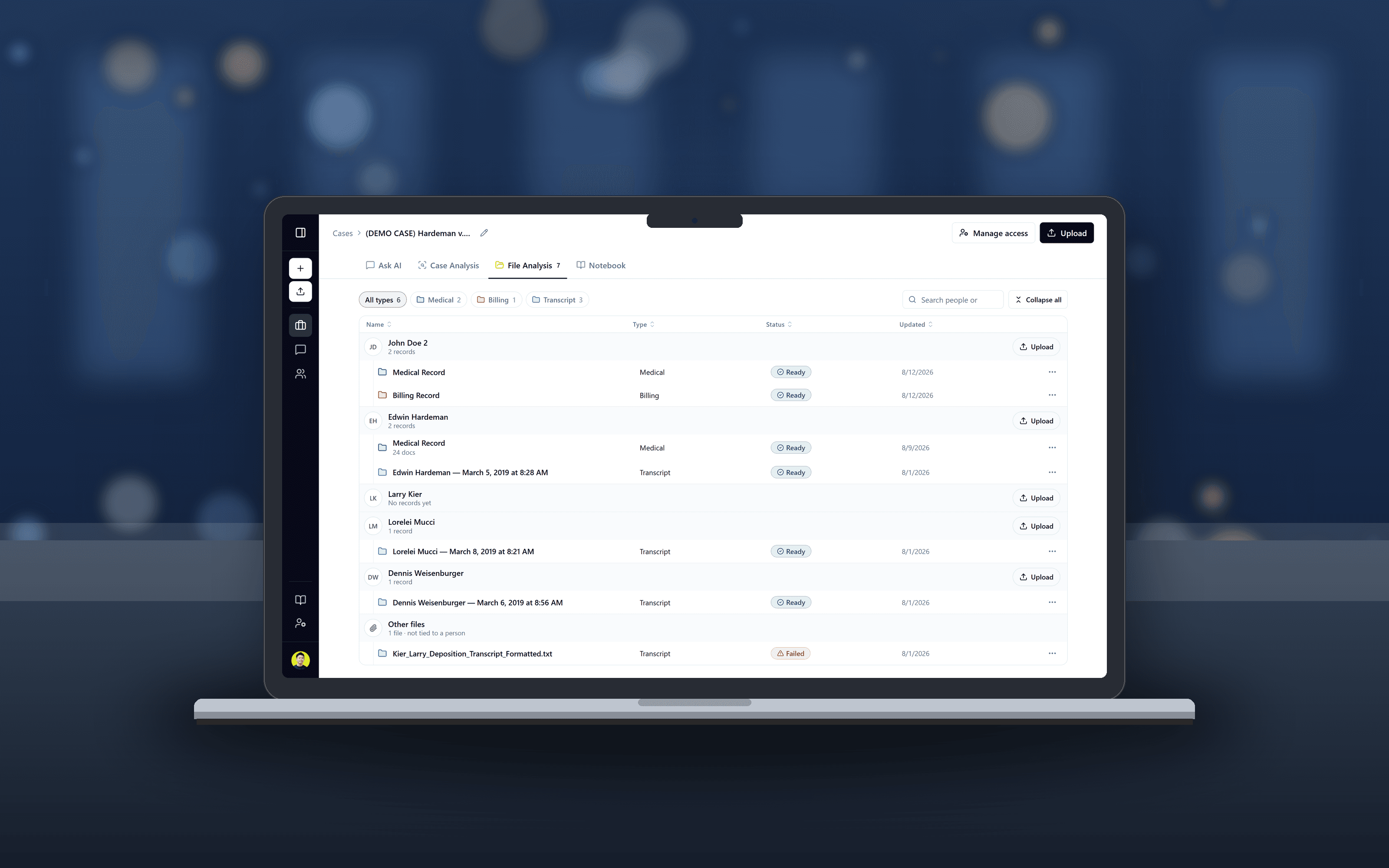
Insurance litigation software should help carriers and defense firms organize claim evidence, assess exposure, test demands, compare testimony with the record, and document how key decisions were reached.
The best tools connect information across the file instead of treating every document in isolation. At a bare minimum, look for these capabilities:
Organize the file early
Claims are moving toward litigation faster. Sedgwick found that among bodily injury claimants who sue, 70% have a lawyer within two weeks of first notice.
By the time defense counsel gets involved, the file may already contain medical records, bills, demand materials, statements, and correspondence. Software should organize that evidence and extract key dates and events. It should also build a usable chronology.
Support an early exposure assessment
Carriers often require defense counsel to evaluate a case soon after assignment. The Hartford's panel guidelines, for example, call for an Initial Case Assessment and budget within 45 days.
That early assessment can influence reserves, settlement authority, litigation strategy, and whether the carrier resolves or defends the claim. The difficulty is that the most important exposure facts may be buried across the file.
A pre-existing injury may affect causation, or a long treatment gap may weaken a damages theory. Insurance litigation software should find those facts early and show the evidence behind them. It should also separate confirmed facts from allegations or interpretations so the team can see how strong the support really is.
Test the demand against the underlying record
Demand packages can present a clean narrative of injury, treatment, damages, and liability. The underlying claim file is often much messier.
Claims executives in the CLM study reported increasing pressure from large demands with short response windows. AI can also make it easier for plaintiff firms to assemble lengthy and polished demand packages quickly.
That makes verification very important.
Litigation and claims software should help answer questions such as:
Does the demand accurately describe the medical record?
Do the billed procedures match the chart?
Does the demand leave out treatment gaps or conflicting findings?
Are the claimed damages supported by the underlying documentation?
How does the coverage bear on the facts?
This requires cross-document analysis. Summarizing a demand and summarizing a medical record separately is not enough.
Compare testimony with the rest of the file
In first-party claims, examinations under oath can play an important role in the coverage investigation. Depositions can shape liability and damages.
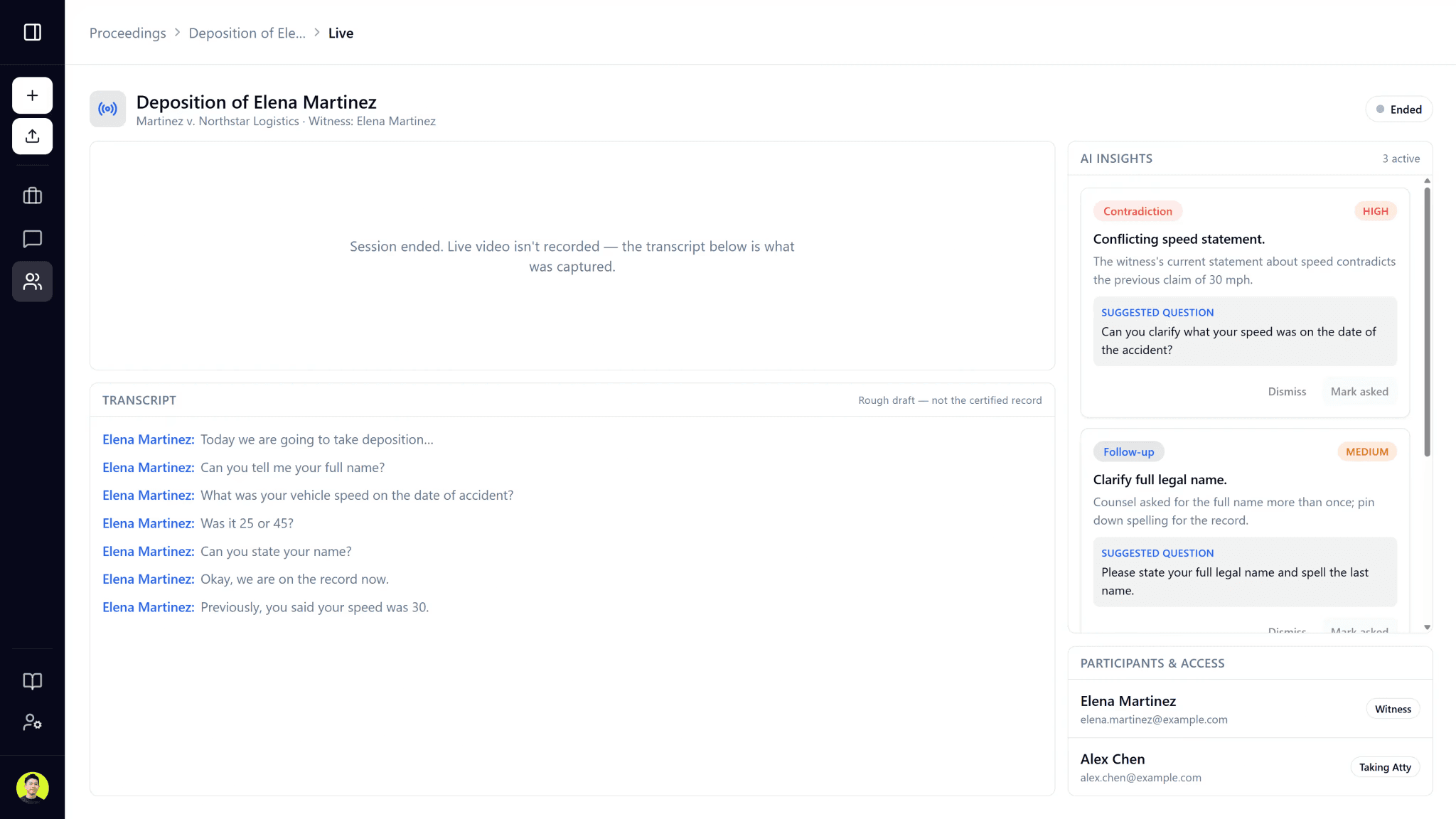
The value comes from comparing that testimony with the FNOL narrative and earlier recorded statements, medical records, bills, and other evidence. A claimant may give a consistent account during testimony while other parts of the file point to contradictions.
The software should ideally make those conflicts easy to find and verify.
Preserve the reasoning behind claim decisions
This is all the more important in coverage and bad faith disputes, where the carrier's handling of the claim may itself become evidence.
The question may later be not only what decision the carrier made, but what information it had at the time and how that information supported the decision.
For that reason, AI findings should be traceable to the underlying source, ideally down to the relevant page and line. Teams need to be able to verify the result and reconstruct the reasoning later.
How We Picked the Tools
We shortlisted seven relevant and widely used platforms and reviewed each against these criteria:
Is it built for carriers, TPAs, or law firms?
What job does it do on a litigated claim?
Does it read across record types or focus on one?
Can you trace each finding to its source document?
What does the vendor say about data security?
Features vary by plan and change quickly, so you have to confirm any must-have capability directly with the vendor.
Tool | Built for | Main job | Reads testimony against records and bills |
|---|---|---|---|
InFactIQ | Carriers, TPAs, litigation teams | Whole-file evidence analysis, depositions and EUOs | Yes, across the claim file |
Wisedocs | Carriers, TPAs, defense firms | Medical record review with clinician QA and risk analyzers | Records and billing; testimony not described |
Verisk Discovery Navigator | Carrier claims teams | Medical record extraction and summaries | Medical records only |
CaseGlide | Carrier claims executives, corporate legal | Litigation intelligence from counsel reports | Chronologies from depositions and IMEs |
CLARA Analytics | Adjusters, legal panel managers | Litigation risk prediction and attorney scoring | Claims data analytics, not file evidence |
Litify | Insurance defense firms | Matter management, billing, AI agents | Reconciles medical encounters with bills |
CoCounsel Legal | Law firms, legal departments | Legal research, analysis, drafting | General document analysis |
These tools solve different problems, so a single ranking would be misleading. We grouped them by what they are built to do.
Evidence Intelligence Across the Claim File




Medical Record Review for Claims


Litigation Management and Analytics for Carriers


Platforms and AI for Defense and Coverage Counsel
Best for: Insurance defense and coverage firms that need matter management and legal research support.
Top pick: Litify

Panel firms get paid only for time that survives carrier billing guidelines. Litify's insurance defense platform is built around that. Its AI drafts time entries as work happens and enforces client billing guidelines before invoices go out.
The latest version of Litify ACE adds AI agents aimed at panel firm work:
Case Setup Agent: Extracts key details from carrier assignment documents to open new matters.
Carrier Status Report Agent: Pre-drafts quarterly status reports from recent matter activity.
Deposition Prep Agent: Scans case files and records to build a deposition preparation document.
Medical chronology: Creates source-linked chronologies and reconciles encounters and bills into one ledger.
Firms can also scorecard carriers on write-downs and track cost per file to justify their rates.
The overlap with InFactIQ is real here. Both Litify and InFactIQ prepare depositions from the case file, and both line up treatment against billing. Litify goes further on running the firm, from time capture to carrier reports.
InFactIQ goes further inside the examination. It tracks admissions and contradictions live and then tests the finished testimony against the claim file.
Honorable mention: CoCounsel by Thomson Reuters

Coverage and bad faith work lean heavily on legal research. Standards vary by state, and a coverage opinion is only as strong as the authority behind it. CoCounsel is Thomson Reuters' AI assistant, grounded in Westlaw and Practical Law content.
At the 2026 AIDA Insurance Law Forum, presenters showed it analyzing a plaintiff's expert report and building deposition questions to challenge a public adjuster's methodology. They also used it to research apportionment doctrine across jurisdictions. Zarwin Baum, a 53-attorney Philadelphia insurance defense firm, reported cutting full-day document review tasks to under 30 minutes.
CoCounsel serves legal research and drafting across practice areas. Teams that need testimony reconciled against records and bills will still want a claims-specific tool.
What to Test Before You Buy Insurance Litigation Software
Before buying insurance litigation software, test it on real claim files for accuracy and source traceability. Pay attention to data handling and workflow fit.
Do not rely only on vendor demos or headline accuracy rates. The best test is whether the tool can find the issues your team already knows are in a messy, closed file.
Run a closed claim you know well
Choose a file where your team already identified the important contradictions, treatment gaps, or other issues. Then see how many the software finds. Pay close attention to what it misses, because on a live claim you may not know something was overlooked.
Check the cited source
Open the page behind important findings and confirm that the source actually supports the conclusion. A real citation attached to a bad interpretation can be harder to catch than an invented one.
Know whether the tool predicts risk or analyzes evidence
Some platforms use historical claims data to predict litigation or settlement risk. Others read the current file and show what the evidence supports. Both can be useful, but they solve different problems. Treat behavioral or demeanor signals cautiously and use them to guide follow-up rather than judge credibility.
Resolve data handling before the pilot
Courts are still working through how AI use affects privilege and work-product protection. In United States v. Heppner (S.D.N.Y. 2026), analysis created with a public AI tool that later becomes useful to counsel was not protected.
In Warner v. Gilbarco (E.D. Mich. 2026), AI-assisted internal analysis retained work-product protection, as K&L Gates summarizes. Because defense counsel represents the insured, carriers and firms should also agree on who controls shared data and who pays for the tool.
See What InFactIQ Finds in a Real Claim File
Litigated claims often turn on details buried across the file. A demand may look persuasive until the medical records, bills, or prior statements tell a different story. A coverage decision may hinge on a single answer in an EUO.
InFactIQ brings that evidence together. It analyzes the full claim file, identifies contradictions and gaps across testimony and records, and links each finding back to the source.
That gives carriers and TPAs a clearer view of exposure, while defense and coverage counsel can build reports, prepare examinations, and test case theories from the same evidence.